Julianna Sparzak Rykoski was the daughter of John and Amelia Sparzak. Many of those who contributed to this family history refer to her as “Grandmother” and so the family history starts with her journey from Poland to Locust Point in Baltimore, Maryland, her subsequent marriage to Antoni Rykoski, and the children that they raised.
Sparzak Home before Immigrating to America – Mlawa, Poland
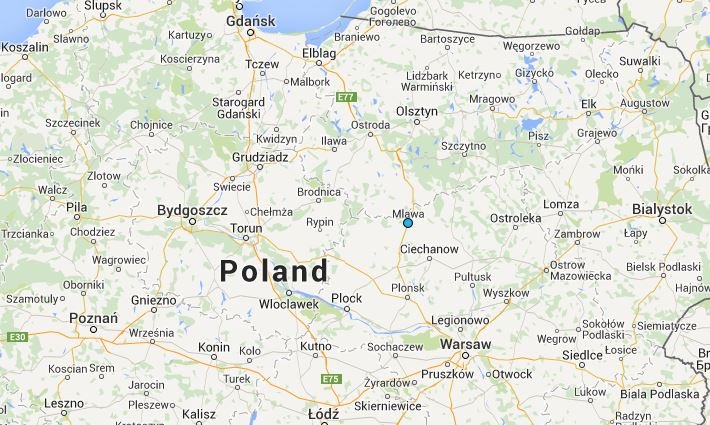
The Sparzak family lived in Mlawa, Poland before immigrating to the United States. Mlawa is a city in central Poland, in the Mazovian Province, located 70 miles north of Warsaw and 50 miles south of Olsztyn. It was granted town rights in 1429 and in the 16th century became the capital city of the Mlawa District. It prospered because of its location along a favorable trading route leading from Russia to Germany (formerly Prussia). From its earliest days it had a customs house and served as a cattle-trading center.
Direct Ancestors
1 Departing Poland (late 1800s)
2 Locust Point, Md. (1600s to 1900s)
3 Sparzak Family (1890s-1900s)
4 Rykoski Family (1910s-1980s)
–Life as a Baltimore Longshoreman
–WW II Memories of Locust Point
5 Stanley & Sophie Waskiewicz Family
— –Lollie, Carolyn & Tony Waskiewicz
6 Charlie & Teenie Rykoski Bernady
8 Anna ‘Annie’ Laura Rykoski Coulborn ALLEN
9 Anthony Jr. & Marjorie Rykoski
In 1564 Mlawa had a population of 429, including many craftsmen engaged in trades such as shoemaker, brewer, pottery, blacksmith, tailor, baker, carpenter, and butcher. By 1616 the population had declined to 284. The Swedish invasion of 1655-to-1660 decimated the town, reducing the population to only 20. A fire in 1692 destroyed the town completely. It was rebuilt and by 1765 had a population of over 100, but a second fire in 1783 again destroyed almost all the houses, necessitating another period of rebuilding.
As these events were occurring in the late 1700s Poland ceased to exist as an independent country. For reasons discussed later, Poland was partitioned into three parts, each occupied by Russia, Prussia (Germany) and Austria. Mlawa, located in the Russia sector, was considered a frontier town because of its location near the intersection of the three partitions, only miles from the German and Austrian partition borders.
Mlawa’s importance increased in the 1850s after the Vistula railway line, which carried traffic to and from Gdańsk was built. The Mlawa train station was a major transfer point where goods from Russian trains, traveling on narrower tracks, were shifted to trains traveling on wider tracks used throughout Europe. Expansion of industry and commerce was accompanied by operation of many enterprises including workshops; an agricultural implements factory and a vinegar factory; three brickyards; a tannery and soap-works; breweries, mills, five oil factories, and three soap factories.
At the start of World War II, a key event in Germany’s invasion of Poland was the Battle of Mlawa. It took place from September 1 to 3, 1939, when the advancing German Army faced strong resistance from the Polish Army. After the fall of Poland Mlawa was occupied by the Nazis, and Polish and Jewish residents endured mass extermination and relocation. Prior to the arrival of the Soviets in 1945, Mlawa was the location of the German massacre of 364 prisoners of a nearby forced labor camp. In January 1945, over 60% of the town’s buildings were destroyed as the Soviets expelled the Germans and continued their march through Poland into Germany.
Situation in Poland in the Late 19th Century
There are three primary, inter-related reasons that explain why families like the Sparzaks and Rykoskis left Poland and came to America in the late 1800s. They are:
1. Partitioning of Poland into three separate parts.
Poland’s government fell into disunity in the late 1700s, leaving the country largely ungoverned and direction-less. Fearing that Russia was going to take advantage of the situation and occupy all of Poland, Prussia (Germany) and Austria proposed a partitioning which was accepted by Russia’s Catherine II. Prussia occupied western Poland and Austria occupied the southern provinces. Mlawa is located in the center of Poland very near the intersection of the borders of the three occupying countries.

2. Uprisings in the 1860s
Poland’s government fell into disunity in the late 1700s, leaving the country largely ungoverned and direction-less. Fearing that Russia was going to take advantage of the situation and occupy all of Poland, Prussia (Germany) and Austria proposed a partitioning which was accepted by Russia’s Catherine II. Prussia occupied western Poland and Austria occupied the southern provinces. Mlawa is located in the center of Poland very near the intersection of the borders of the three occupying countries.
3. Persecution and Efforts to Eradicate the Polish Culture
During this same period Polish society was undergoing deep and far-reaching social, economic and cultural changes. The failure of the January 1863 Uprising caused major psychological trauma and became a historic watershed, sparking development of modern Polish nationalism. After 1863 Russia attempted to eradicate the Polish Culture, making Russian the official language and designating all people in the occupied lands as Russian citizens. Prussia (Germany) was doing the same, forcing Germanic language and culture on the part of Poland that it controlled. Effectively, Poland ceased to exist as a separate nation.
This eradication of Polish culture involved strict controls and increased persecution. The Russian and German languages were imposed on all public communication, and the Catholic Church was severely repressed; public education was increasingly subjected to Russian and German measures and Polish education was discontinued, except where it was taught through unofficial, illegal efforts. Russian and Prussian interests began aggressively purchasing Polish lands and colonizing them with Russian and Prussian colonists.
Despite these efforts to suppress Poland’s language, culture and traditions, the country experienced some positive effects. Poland’s competitiveness was increased through economic changes, increased availability of capital, and productivity improvements in Polish-owned industrial, agricultural, and other businesses. Efforts were made to improve the educational and intellectual development of the common people. Many libraries and reading rooms were established in small towns and villages, and numerous printed periodicals reflected the growing interest in popular education. Scientific and educational societies were active in a number of cities.
Waves of Polish Immigration to the United States
The events of the mid-to-late 1800s initiated multiple distinct waves of Polish immigration to the United States. The first and smallest, caused by the partitioning of Poland, lasted from roughly 1800 to 1860 and was largely made up of political dissidents and those who fled because of the dissolution of their homeland.
A second and far more significant wave took place between 1854 and the early 1900s, when 2.5 million Poles immigrated to the United States. In 1854 about 800 Polish Catholics immigrated to Texas, symbolizing the opening of America to the Poles and opening the immigration flood gates. Immigrants clustered in Middle Atlantic and Midwest cities and towns where they became steelworkers, meatpackers, miners, and autoworkers. This wave peaked in the 1890s.
These waves were fueled by early immigrants who wrote enthusiastically about the many opportunities available in the United States and by transportation improvements which made the journey less arduous. Shipping lines such as the North German Line and the Hamburg American Line started booking point to point passage from Poland to the United States, combining overland and transatlantic passage and simplifying border crossings.
It is likely that a combination of economic opportunity and cultural and religious repression were factors motivating the Sparzaks and Rykoskis to leave Poland for America. Regardless of the reasons, the families made the long trek, arriving and settling in Locust Point, Baltimore Maryland.