3 Sparzak Family (1890s-1900s)
This chapter examines the Sparzak family during their years in Poland and the immigration to the United States. It begins with Jan Sparzak (1871-1937) and Emelia Lotarski Sparzak (1872-1935) and documents their journey to the U.S., their children, and their years spent in Locust Point. Note that they are referred to as John and Amelia in various documents, but their Polish names were Jan and Emelia.
Sparzak Family in Poland
Jan Sparzak was born about 1871 and lived until 1937. He was born in Mlawa, Poland during the time that Poland was partitioned – Mlawa was located in Russian-occupied Poland very near the intersection of German-occupied and Austrian-occupied Poland as discussed in Chapter 2. This fact is important because it explains why some official documents record the family as being Russian, rather than Polish.
Jan’s father, Gregory (Grzegorz) Sparzak, was born about 1828. Jan’s mother was named Mary but she died of cholera in Poland in 1899. Since Jan, his sister and brother were born when Gregory was in his 40s it is entirely possible that Gregory may have been married more than once and fathered additional children in Poland.
Jan had a sister, Maryann (b. 1869) and a brother, Joseph (Josef b: Mar 13, 1875) who was a mailman in Poland. At the time that Jan and his siblings were born Poland was still reeling from the January 1863 Uprising (see Chapter 1) and Russia, under orders from Tsar Alexander II was making every effort to eradicate the Polish culture. During the 1870s Russia levied restrictions about use of the Polish language and cultural expression. It was illegal to speak Polish or to engage in Polish cultural traditions and those who did so could be arrested. It is likely that John’s parents were upset by these actions and the climate certainly influenced the children’s formative, highly impressionable early years.
Direct Ancestors
1 Departing Poland (late 1800s)
2 Locust Point, Md. (1600s to 1900s)
3 Sparzak Family (1890s-1900s)
4 Rykoski Family (1910s-1980s)
–Life as a Baltimore Longshoreman
–WW II Memories of Locust Point
5 Stanley & Sophie Waskiewicz Family
— –Lollie, Carolyn & Tony Waskiewicz
6 Charlie & Teenie Rykoski Bernady
8 Anna ‘Annie’ Laura Rykoski Coulborn ALLEN
9 Anthony Jr. & Marjorie Rykoski
Jan Sparzak left for America only 9 weeks after Julianna’s birth. He departed from Bremen, Germany aboard the S.S. Roland on March 12 and arrived in Baltimore on March 28, 1896. The specific reason he decided to leave for America is not known.
He likely traveled by train to Bremerhaven and then boarded the S.S. Roland which arrived at Locust Point, leaving the family behind until he could save money for their passage. It is likely that he temporarily resided in the boarding house run by Jennie Koether as discussed in Chapter 2, obtained employment as a stevedore, and started saving so that he could bring his family to America when he had enough saved to pay for their passage.
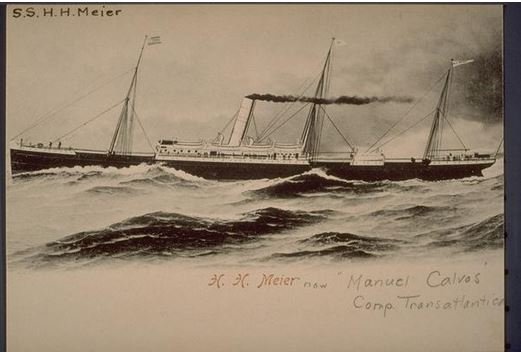
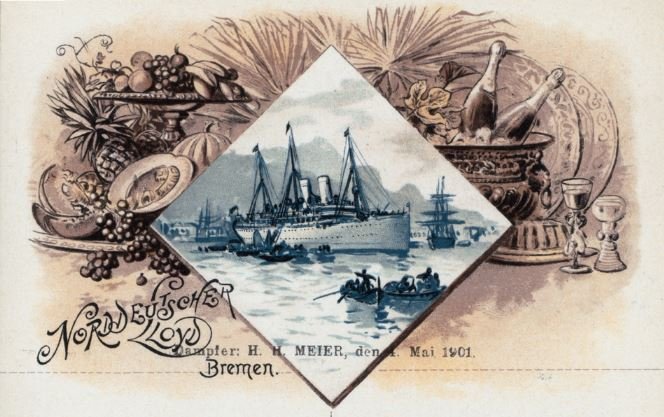
Emelia, the three children and Gregory, her father-in-law traveled to America three years later. They left Bremen, Germany in August and arrived in September, 1899, traveling on the H. H. Meier[1], of the Norddeutscher Lloyd Bremen Steamship Company. The typical cost of passage in steerage at the turn of the century was about $30 per person.
Jan’s brother, Joseph, followed in 1900, leaving from Bremen, Germany aboard the Roland and arriving in Baltimore in March, 1900. Jan Sparzak is listed as his sponsor on the ship’s manifest. After getting settled he sent for his wife, Marianna and she arrived in May 1901.
[1] H.H. MEIER / LUCANIA / MANUEL CALVO / DRAGO 1891 – 1959
The H.H.MEIER was a 5140 ton ship built in 1891 for North German Lloyd, by Armstrong, Mitchell & Co. of Walker-on-Tyne. She had one funnel, three masts, twin screw, and a max speed of 13 knots. She was 421ft in length x 48ft beam and had accommodation for 75 1st, 300 2nd, and 1,000 3rd class passengers. She was launched as the LUCANIA for MacIver & Co. and was bought by NDL in 1892 and renamed H.H.MEIER (after the founder of Norddeutscher-Lloyd). On 12/27/1892 she made her maiden voyage for NDL from Bremen – Southampton – NY and in 1893, transferred to Bremen – NY – Baltimore run. In 1901 she was sold and renamed MANUEL CALVO and was rebuilt. In 1919 she struck a mine off the Turkish coast while repatriating foreigners with the loss of 151 lives. She made her last voyage in 1931 and was then laid up until 1939 when she was rebuilt as a cargo vessel. In 1952 she was renamed DRAGO, still under the Spanish flag and in 1959 was scrapped in Spain at the remarkable age of 68.
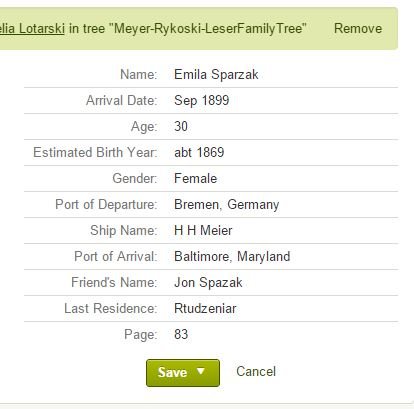
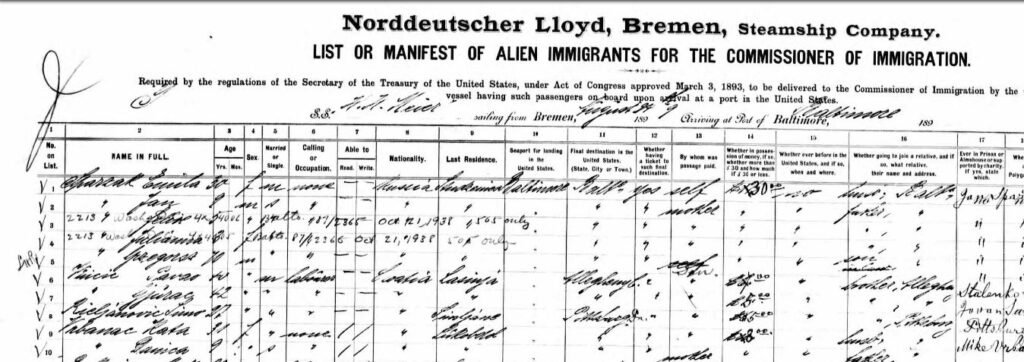
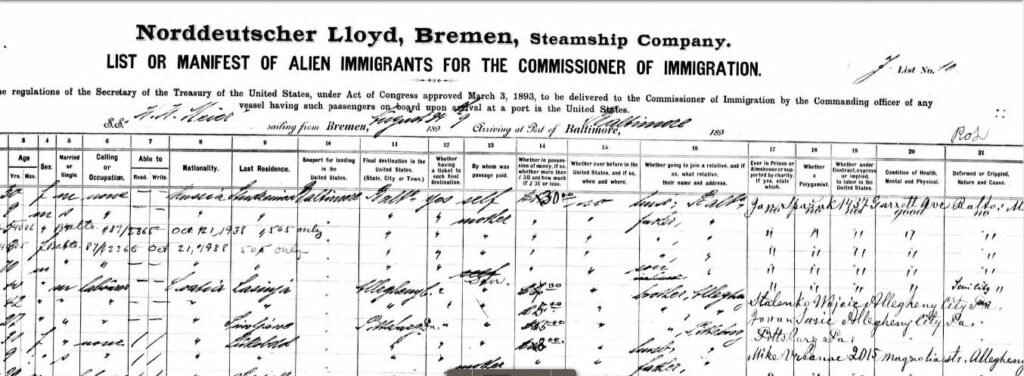
According to the 1899 ship’s manifest, the sponsoring individual in America was Jan Sparzak and he lived at 1437 Garrett Avenue. Recall from Chapter 2 that Garrett Avenue in Locust Point was later renamed to Reynolds Street. The family is also listed at this address in the 1900 U.S. Census. (Note: Their youngest son is listed as Alexander in this census).
AMERICAN-BORN SPARZAKS
In the first two decades of the 20th Century, the family rapidly expanded in size. Children born in Baltimore were:
- Josaphine Sparzak, born May 1900
- Frances Sparzak, born July 19, 1901
- Antoinette “Teenie” Sparzak, born in 1903
- Stanislope “Stanley” Sparzak, born in 1905
- Alexander Sparzak, born in 1907
- Walter Sparzak, born in 1910
- Felicia “Evelyn” Sparzak, born December 29, 1914.
According to verbal family history, two other children died at an early age of influenza and three were deceased at birth (“still born”). The 1900 U.S. Census conducted in June 1900 lists Josaphine Sparzak with a birth date of May 1900, but she is not recorded in later Census documents and likely was one of the two who died from influenza. She was likely named after Jan and Emelia’s next door neighbors in 1900, whom had a four year old daughter named Josaphine Price.
The other child who likely died of influenza was Walter Sparzak, who was listed in the 1910 U.S. Census as a newborn, but was not listed in later documents. The 1918 Flu Pandemic accounted for 50 million deaths worldwide. It is like that Walter became victim during this period.
Although all of the children likely did not live at home at the same time since both John and Julia had married and moved out by the time Evelyn was born in December, 1914, there were likely as many as 10 family members living at home on Reynolds Street at some point. As can still be seen today, the Reynolds Street houses are very small and living conditions for a family of ten were probably very tight.
JAN AND EMELIA IN LOCUST POINT 1900-1940
The U.S. Census documents from 1900 to 1940 tell us a number of things about the Sparzak family:
- 1900 U.S. Census: Jan came to the U.S. in 1896 and by the time Emelia and the children arrived in 1899 he had secured a home at 1439 Garrett Avenue (later renamed to Reynolds Street). There is a slight discrepancy in that Amelia noted the address as 1437 on the ship’s manifest, but the house is listed as 1isted as 1439 in the 1900 U.S. Census. In this Census the family includes Jan and Emelia, Jan’s father Gregory, and children John, Alexander, Julia and Josaphine.
- 1910 U.S. Census: By 1910 Jan, Emelia, children John, Phillip, Julia, Frances, Tina, Stanley, Alexander, Walter and father Gregory had moved to 1357 Reynolds Street.
- 1920 U.S. Census: The family still resided at 1357 Reynolds Street in 1920 and included Jan and Emelia, Jan’s father Gregory, and children Phillip, Frances, Christina, Stanoslope, Alexander, and Evelyn. By this time John and Julia had married and left home.
- 1930 U.S. Census: Jan and Emelia, now in their 60s, had moved from 1357 to 1422 Reynolds Street because the 1300 block was demolished in 1924 to make way for construction of the B&O Grain Elevators. Jan’s father, Gregory had passed. Children at home included Stanley, Alexander and Evelyn. This is the last entry for John and Amelia since Amelia passed in 1935 and John passed two years later, in 1937.
The Sparzak and Rykoski families lived through extraordinary times in their Reynolds Street homes. Events included the end of World War I in 1918, the influenza pandemic which occurred after the end of the war. The pandemic infected a fifth of the world’s population and killed 50-to-100 million people worldwide and 675,000 Americans, ten times as many as in the world war. It reduced the average US lifespan by 10 years.
Automobiles were mass-produced. The aviation industry was in its infancy. The Titanic struck an iceberg and sunk in 1914 killing 1,500 passengers. After years of Women’s Suffrage demonstrations women finally received the right to vote in 1919 through ratification of the 19th Amendment to the U.S. Constitution.
In the “Roaring 20s” there were technological advances such as the first telephones and electric kitchen appliances. The Stock Market Crash of 1929 ended the decade and had a devastating effect on many American families who lost savings and became unemployed. The Great Depression persisted through the 1930s and ultimately ended with the start of World War II.
<div style=”height: 20px;”>
<p class=”wp-block-paragraph”>Jan and Emelia Sparzak did not live to see the end of the Great Depression, both passing in the mid-1930s. There are only a few details passed down by Julianna and official records like the U.S. Census. Several photos have been passed down that may have been Jan and Emelia when they served in the Governor’s residence in Poland.</p>